
The Real Reason Your B2B Marketing Is Failing
Published October 9, 2025. Updated August 9, 2026
Somewhere in your business’s LinkedIn content calendar is a post announcing a new hire, and nobody is booking a meeting because of it.
B2B LinkedIn marketing has developed a sameness problem. Companies post consistently, explain their services, celebrate internal milestones, comment on industry news and publish educational content because those are the things a professional business is supposed to do.
None of that content is necessarily bad, which is exactly what makes the problem difficult to see.
Years of writing LinkedIn content for businesses has shown me how easily good ideas get polished into the same editorial voice.
Anything too opinionated gets softened, service education becomes another explanation of something the audience already knows, and industry commentary starts sounding indistinguishable from every competitor in the feed.
The marketing team often knows it, too. They push for a more distinctive identity, but changing the tone feels risky when the existing approach is polished, familiar and easy to approve.
AI has only accelerated the problem. The feed is now filled with competent captions, tidy frameworks, educational carousels and perfectly acceptable advice that all begin to sound remarkably similar.
Quick answer: B2B LinkedIn marketing stops working when publishing becomes the objective and the content becomes interchangeable with everything else in the feed. Generic service education and polished company updates can keep a page active, but they rarely give decision-makers a strong reason to remember the business behind them.
What Is B2B LinkedIn Marketing?
B2B LinkedIn marketing is how businesses use LinkedIn to build awareness, credibility and relationships with the people who influence buying decisions.
That can include company-page content, founder and executive posts, subject-matter experts, employee content, comments, conversations, paid campaigns and direct outreach. The strategy gets stronger when those pieces work together instead of LinkedIn becoming another content calendar the marketing team has to keep full.
The value also isn’t limited to what happens right after someone sees a post.
A decision-maker might come across an idea today, recognize the person behind it a month from now and remember the company six months later when they actually need what it sells.
LinkedIn’s B2B Institute connects this to mental availability, essentially whether your brand comes to mind when a relevant buying situation happens. Its research also suggests that simply not knowing a brand exists can be a bigger barrier to B2B growth than actively rejecting it.
That’s an important way to think about LinkedIn because a post doesn’t have to generate a lead today to have done something useful.
Is LinkedIn Still Worth It for B2B Marketing in 2026?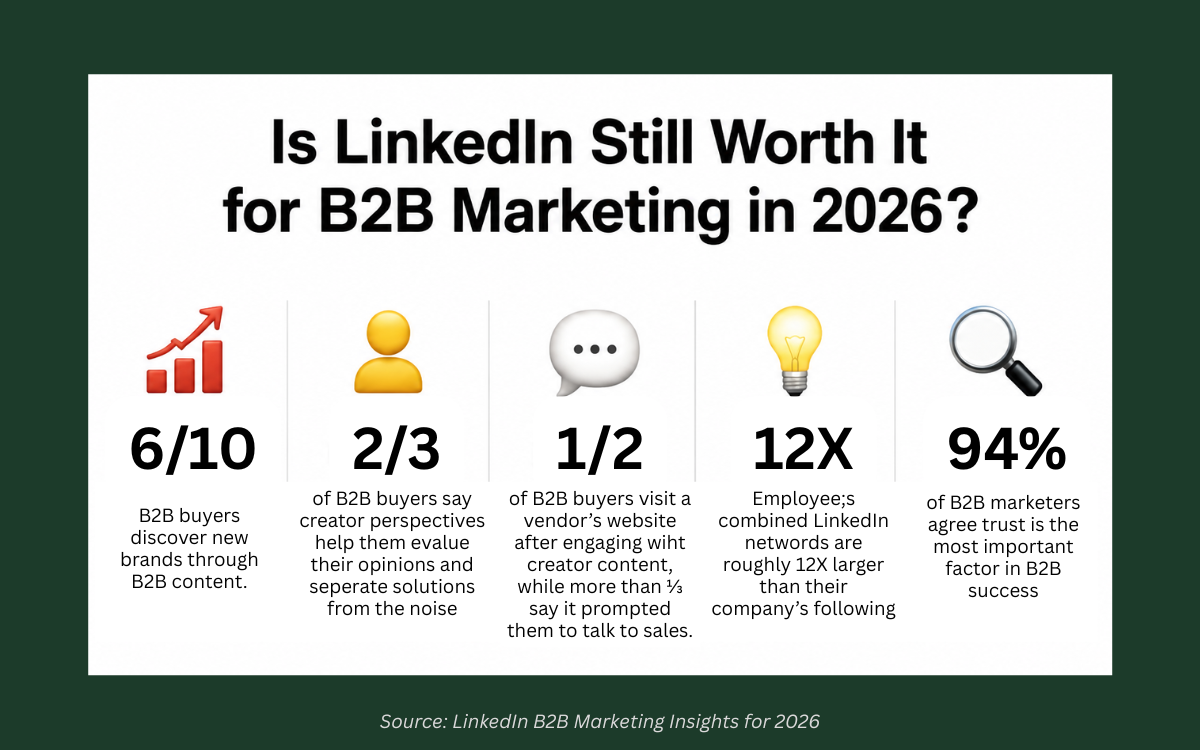
Why Doesn’t Consistent LinkedIn Posting Work?

Consistency works when people consistently receive something worth noticing.
Publishing three times a week doesn’t compensate for content that could have appeared on any competitor’s page.
Repeating generic ideas can reinforce the very problem the posting schedule was supposed to solve because audiences become accustomed to scrolling past the content.
A typical B2B feed is filled with posts explaining why cybersecurity matters, five reasons to improve a business process, an employee spotlight, an industry awareness day and another announcement beginning with some variation of “We’re excited to share.“
Each of those topics can have a legitimate communications purpose.
An employee story can be excellent when there is an actual story to tell, while service education can be useful when it answers a real question with expertise the reader could not easily get elsewhere.
The problem begins when those formats become the entire strategy.
LinkedIn and Edelman’s research has repeatedly found that decision-makers value thought leadership capable of challenging assumptions, providing evidence and introducing useful perspectives. Simply publishing consistently does not accomplish any of those things by itself.
Consistency should build familiarity with something distinctive, it shouldn’t automate forgettability. Big difference.
Why Educational LinkedIn Content Alone Isn’t Enough
Educational content still belongs on LinkedIn. The problem is that being useful isn’t automatically the same as being memorable anymore.
An industrial equipment manufacturer can explain why preventative maintenance matters, how to reduce unplanned downtime or what to look for when choosing a replacement part. That’s useful information, but your audience can also get it from a supplier website, a trade publication, a competitor or an AI tool in about thirty seconds.
What they can’t get anywhere else is your experience with it.
Maybe your team stopped recommending a commonly specified material because you’ve seen where it fails. An accountant might talk about the mistake clients keep making before they ask for help. A construction company could explain a decision its project managers make behind the scenes that customers rarely know about. A SaaS team might explain why the feature customers keep requesting would actually make the product worse.
You’re still educating people but now you’re giving them something they couldn’t have learned from anyone else.
What Should B2B Companies Post on LinkedIn?
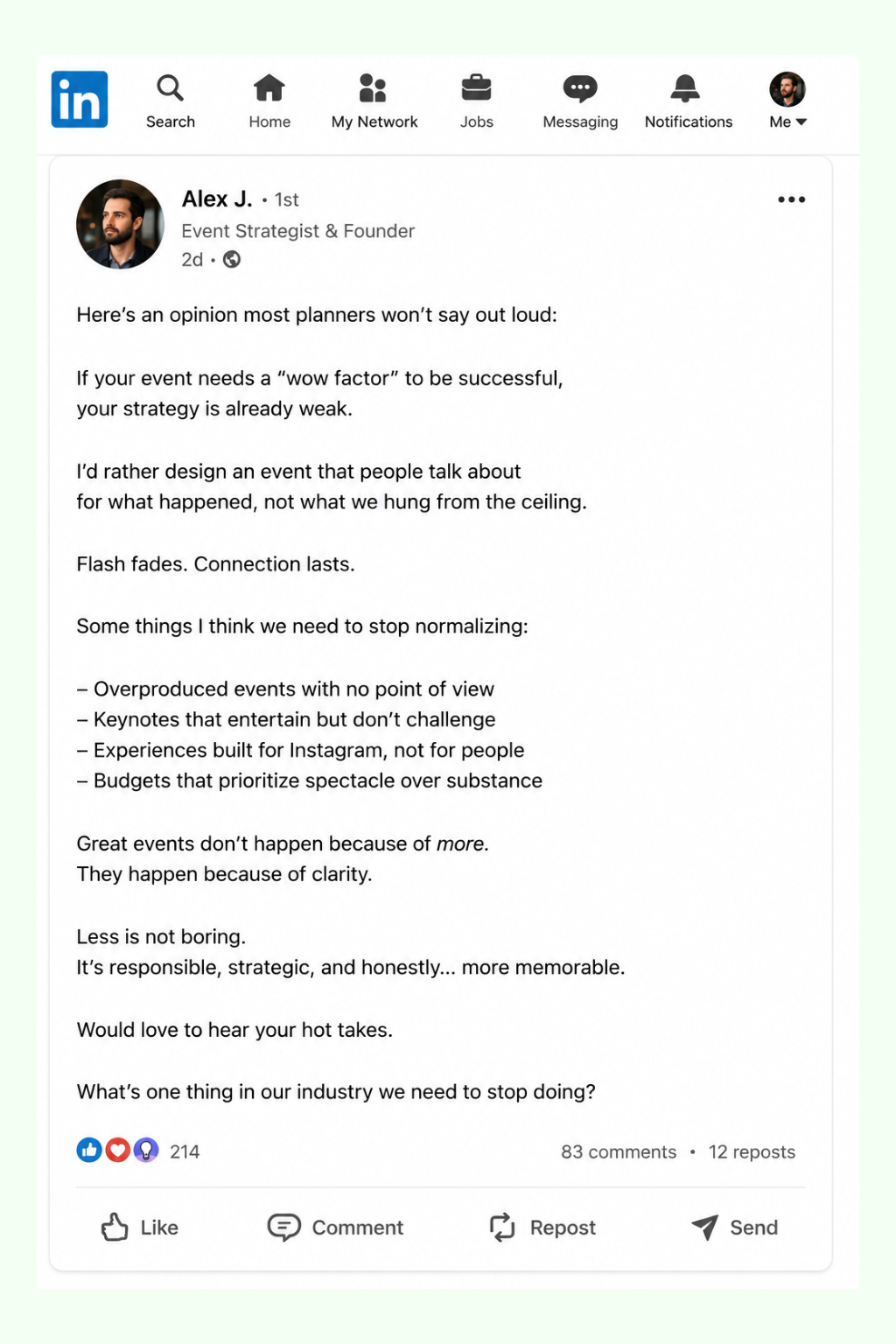
Strong B2B LinkedIn content gives people something they can’t get from reading another service page or Googling the topic.
The content types below work because they pull from what your business actually knows, sees and does every day.
Decision-Based Content
Decision-based posts explain why a business chose one path over another, which might include a tool it abandoned, a service it stopped offering, an investment it made or a common practice it deliberately avoids.
A software company could explain why it shortened a free trial despite conventional wisdom favouring a longer one. The useful information is not simply that the company changed the trial; the value comes from understanding the evidence and judgment behind the decision.
Behind-the-Scenes Expertise
Behind-the-scenes content works when it exposes how the work actually happens rather than merely proving that employees exist.
A project manager explaining how the team evaluates a difficult trade-off provides meaningful access to expertise. A photograph of employees standing beside a cake does not accomplish the same thing unless there is a story around that moment that matters to the audience.
The strongest behind-the-scenes content lets outsiders see decisions, processes and expertise they would not normally encounter.
Customer and Market Patterns
Businesses pick up a ton of useful insight just by doing the work every day.
Think about the questions clients keep asking, the mistakes your sales team sees over and over, the problems that tend to show up together, or something your experts have started noticing that wasn’t happening a year ago.
Instead of another post about onboarding best practices, talk about what you’re actually seeing: “We’ve noticed the same problem derail several implementations before onboarding even gets off the ground.”
Now you’re not repeating advice people have heard a hundred times. You’re sharing something your team only knows because they’ve seen it happen enough times to recognize the pattern.
Strong Industry Perspectives
A business doesn’t need to disagree with conventional wisdom for attention, but it should be willing to explain when its experience contradicts accepted advice.
The strongest version is not an empty declaration that everybody else is wrong. It explains what the common recommendation is, where the team has seen it break down and what it would consider instead.
That turns an opinion into useful expertise.
Opinionated Education
Educational content gets a lot more interesting when you’re willing to tell people what you actually think.
Instead of walking your audience through every possible solution, tell them which two you’d prioritize and why.
If businesses keep getting something wrong, don’t give them another definition of the problem. Explain what they’re misunderstanding and what you’ve learned from seeing it play out in the real world.
People can find the textbook answer anywhere, but what they can’t find anywhere is your take on it.
Why B2B LinkedIn Content Needs a Recognizable Point of View
Professional does not have to mean personality-free.
Businesses get cautious on LinkedIn because the content is public, clients can see it and someone internally usually needs to approve it.
Anything slightly opinionated gets softened, humour disappears, interesting phrasing gets cleaned up and the final post is perfectly professional but could have come from almost any company in the industry.
That process protects the company from saying something mildly interesting while making it almost impossible to remember.
A recognizable B2B presence should sound like the business and the people inside it, just with the volume turned up slightly.
Maybe that voice is analytical, direct, witty, deeply technical, curious, candid or a little irreverent. It depends entirely on who you are.
You don’t need to invent some LinkedIn personality that sounds nothing like your actual business. You just need to stop editing out everything that makes you sound like one.
The research backs that up.
Buyers have expressed a preference for identifiable authors, more human language and ideas that challenge their assumptions, which tells us credibility and personality aren’t competing for space in B2B thought leadership. LinkedIn-Edelman B2B Thought Leadership Impact Report
Strong B2B content can have both.
Should B2B Companies Use the Company Page or Personal Profiles?
Company pages still have a role in B2B LinkedIn marketing, but they shouldn’t be expected to carry the entire strategy.
Your company page gives the business an official presence, reinforces positioning, shares legitimate company news and gives prospective customers somewhere to learn more about the organization.
The problem starts when every idea, opinion and piece of expertise gets pushed through that same corporate voice.
Personal profiles give that expertise a person. Founders, executives and subject-matter experts can share what they’re seeing, explain how they think and contribute perspectives that would lose something if they were rewritten as another company post.
The strongest approach uses both, with the company page supporting the brand and real people giving it a voice.
Does Humour Work in B2B LinkedIn Marketing?
Humour can work incredibly well for B2B brands, but that doesn’t mean every company needs to start making memes.
The point is to give people something to feel while they’re scrolling.
Humour can do that, but so can curiosity, surprise, candour or a genuinely good story. A serious professional-services company doesn’t need to be funny, but it also doesn’t need to sound like every sentence went through six rounds of legal approval.
The tone still has to make sense for the business. If humour isn’t naturally part of the brand, forcing it won’t make the content more interesting.
Forced humour is just as obvious as forced professionalism, and neither gives people much reason to keep reading.
Why Being Remembered Matters More Than Going Viral
Going viral feels good because you can see the payoff immediately. Impressions climb, engagement spikes and suddenly you have a very satisfying screenshot for the monthly report.
B2B buying doesn’t usually work that way.
The B2B Institute’s 95-5 research suggests that roughly 95% of potential buyers may be out of market at any given time. (The B2B Institute’s 95-5 Rule)
In other words, many of the people seeing your LinkedIn content aren’t looking for what you sell right now.
Part of marketing to those future buyers is giving them something memorable enough to come back to mind when that changes.
That makes context around your LinkedIn numbers important.
A post with 25,000 impressions from people who have little connection to your market may be worth less than one seen by 800 relevant people who keep encountering your company and its expertise over time.
Reach still matters because people can’t remember a business they’ve never encountered. It just isn’t the end goal.
Your audience doesn’t need to remember every post you publish. They need to remember who published it.
What Does a Distinctive B2B Brand Look Like on LinkedIn?
Ramp is a good example because fintech could easily produce some painfully corporate content.
Compliance, risk, expense management, procurement and accounting aren’t exactly topics begging for personality.
Instead, Ramp puts identifiable people and its internal culture into the brand.
Its own writing describes a company where “everyone is a builder,” and employees regularly show up as part of the story rather than having every idea filtered through an anonymous corporate voice.
The point isn’t to sound like Ramp. A construction company shouldn’t sound like a fintech startup, and an accounting firm doesn’t need to start making memes because somebody else gets engagement from them.
Distinctiveness comes from figuring out what’s already interesting about your business and making more of it visible. Your people, opinions, decisions and way of doing things are much harder for a competitor to replicate than another educational post.
Which LinkedIn Marketing Metrics Actually Matter?
Likes and impressions are useful, but they don’t tell you whether your LinkedIn content is actually reaching the right people or making them interested enough to do something next.
That’s why I wouldn’t judge a B2B LinkedIn marketing strategy on engagement numbers alone. Pay attention to what happens after someone sees your content, and whether the people responding to it are actually the people you want to reach.
- Relevant profile views and connection requests tell you whether the content made someone in your target audience curious enough to learn more about the person behind it.
- Comment quality matters more than a pile of generic reactions. If someone adds to your point, challenges it or brings up a related problem they’re dealing with, they actually paid attention.
- Repeat engagement is worth watching too. When the same relevant people keep showing up across multiple posts, there’s a good chance they’re starting to recognize you.
- Inbound conversations are an even stronger signal, especially when someone mentions a specific post or idea. Branded searches and direct website traffic can also pick up interest that started on LinkedIn but didn’t turn into an immediate click.
The metrics you track should match what you’re asking the content to do. If you’re using LinkedIn to build recognition and future demand, judging every post by how many leads it generated that week is going to make perfectly good marketing look like it isn’t working.
How Often Should a B2B Company Post on LinkedIn?
There’s no magic posting frequency for LinkedIn. For many B2B businesses, two or three strong posts a week is a good place to start, while companies with more experts and genuinely useful things to say may be able to post more often.
The important part is whether you can maintain that schedule without creating filler. If posting more means stretching one good idea into seven watered-down posts, you’re not helping the strategy.
Consistency should make your business familiar, not make your content predictable.
When Does LinkedIn Marketing Turn Into Leads?
B2B LinkedIn marketing often influences a lead before it directly produces one.
A decision-maker might see an executive’s post, recognize the name a few weeks later, read something from one of the company’s experts and eventually visit the website. None of those interactions needs to happen while they’re actively looking for a provider.
When they eventually are, that familiarity matters. They may already recognize the company, know one of its people or remember a perspective they’ve seen before. Instead of discovering the business for the first time, they’re starting with some idea of who it is.
There can be signs that this is happening before a lead ever appears: relevant profile views, repeat engagement, qualified connection requests, branded searches and inbound messages that reference something you’ve published.
A booked meeting might come later. The content started doing its job when someone remembered who said it.
What Should B2B Companies Avoid on LinkedIn?
A few things can make a B2B LinkedIn feed feel active without making it interesting.
- Too many company announcements: Hires, awards and milestones have a place, but your audience needs a reason to care beyond the fact that they happened.
- Press-release writing: If nobody at the company would actually speak that way, don’t make every LinkedIn post sound that way either.
- Generic educational content: Useful information is fine. Information your audience could get from any competitor needs your experience or perspective added to it.
- Keeping your experts invisible: Some of your best content ideas are probably sitting with the people doing the work every day. Let people hear from them.
- Engagement for engagement’s sake: A post can get plenty of attention from people who will never matter to the business.
- A CTA on everything: Not every post needs to ask someone to book a call, download something or visit your website.
The problem is when staying active becomes the strategy, and most of what you publish gives people no real reason to remember your business.
How Do You Build a Better B2B LinkedIn Marketing Strategy?
A better B2B LinkedIn marketing strategy starts by deciding what you want people to know about your business beyond the services you sell, and what you want them to remember when they scroll away.
Frequently Asked Questions
Is LinkedIn worth it for B2B marketing?
LinkedIn can be particularly valuable for B2B marketing because it combines professional networks, company information and individual expertise on the same platform. LinkedIn and Edelman’s research also shows that decision-makers use thought leadership to assess organizations and that high-quality thinking can influence buyers beyond the people directly targeted by sales. (Edelman)
What should B2B companies post on LinkedIn?
Strong B2B LinkedIn topics include expert observations, customer and market patterns, decision-making stories, lessons from real work, industry perspectives, original research, behind-the-scenes expertise and educational content with a clear point of view. The strongest topics reveal something about how the business thinks rather than simply explaining what it sells.
Should a B2B company use its company page or personal profiles?
Both can play valuable roles. A company page provides the official brand presence and reinforces positioning, while founders, executives, employees and subject-matter experts can attach recognizable people and firsthand experience to ideas. LinkedIn reports that 67% of buyers prefer thought leadership with an identifiable author, while 77% prefer deep subject-matter expertise over high-level executive commentary. (LinkedIn Business Solutions)
How often should a B2B business post on LinkedIn?
There is no posting frequency that guarantees LinkedIn results. Two or three worthwhile posts per week can be a practical starting point for many businesses, but the right cadence depends on available expertise, resources and whether the organization can maintain quality without publishing filler.
Does founder-led content work on LinkedIn?
Founder-led content can strengthen a LinkedIn strategy when the founder has genuine expertise and a recognizable perspective, but founders should not automatically become the only people allowed to represent the business. Executives, employees and subject-matter experts can all contribute, and LinkedIn’s research indicates that buyers place significant value on identifiable authors and specialized expertise. (LinkedIn)
Does humour work on LinkedIn for B2B brands?
Humour can make B2B content more memorable when it naturally fits the organization, but humour itself is not a strategy. Brands can also create emotional distinctiveness through candour, curiosity, surprise, storytelling and strong observations without trying to become comedic.
How long does LinkedIn marketing take to work?
There is no credible universal timeline because B2B buying cycles, audience size, existing awareness, content quality and category dynamics vary significantly. LinkedIn should generally be treated as an ongoing awareness, credibility and demand-building channel rather than a short campaign expected to produce a predictable number of leads within several weeks.
Can LinkedIn generate B2B leads organically?
Yes, although organic LinkedIn content can influence a lead long before someone sends a message or fills out a form. Repeated exposure to relevant expertise can build recognition and consideration before a buying situation occurs, which is why last-click attribution alone does not capture every way LinkedIn contributes to demand.
What is thought leadership on LinkedIn?
Thought leadership is content that contributes expertise, evidence, analysis or a distinctive perspective to a business conversation rather than simply promoting a company’s products and services. LinkedIn’s research indicates that buyers value trusted data, specialized expertise, identifiable authors and ideas that help them think differently about a subject.
Stop Keeping the LinkedIn Lights On
A full content calendar can create the reassuring impression that marketing is happening, even when very little is being communicated that a decision-maker could associate specifically with the business.
That distinction will matter even more as AI makes competent, polished business content faster and cheaper to produce. When virtually any company can publish a technically accurate explanation of the same industry topic, simply being informative becomes a weaker source of differentiation. The advantage shifts toward the expertise that is harder to reproduce: accumulated experience, judgment, original observations, recognizable people and a perspective shaped by actually doing the work.
B2B LinkedIn marketing does not need every post to be revolutionary, controversial or immediately attributable to a lead. It needs the cumulative body of work to become recognizable enough that the audience can eventually distinguish your company’s thinking from everyone else’s.
As competent content becomes easier to manufacture, the businesses worth remembering will be the ones whose expertise still has fingerprints on it.