
I recently rebuilt my entire website myself, without a developer, SEO expert, AEO specialist, or design team.
A few years ago, that would have meant staying within the limits of what I already knew how to do or bringing in help for the parts I didn’t.
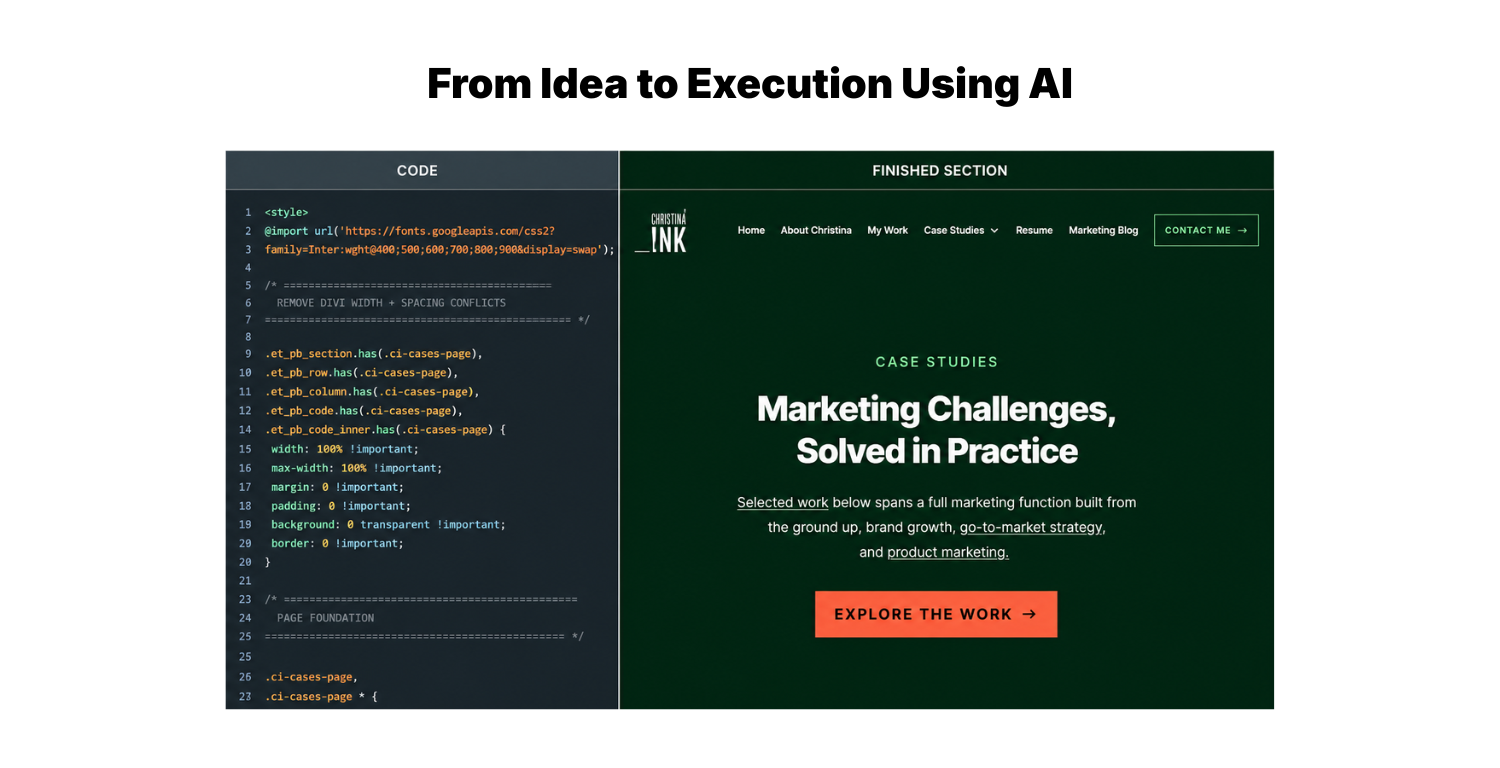
With AI, I could take the website content strategy I had mapped out and execute across copy, SEO, design, and code without stopping every time I hit the edge of my own skill set.
AI gave me more room to experiment with the site than I had before. I could rethink an entire page, test a different structure, build something I couldn’t code on my own, dig into a technical SEO problem, or keep pushing an idea until it felt right.
Somewhere in the middle of having all those options, I realized the hardest part was knowing which decisions would improve the user experience, strengthen search visibility, and make the site easier to discover through search engines and LLMs.
What Is a Website Content Strategy
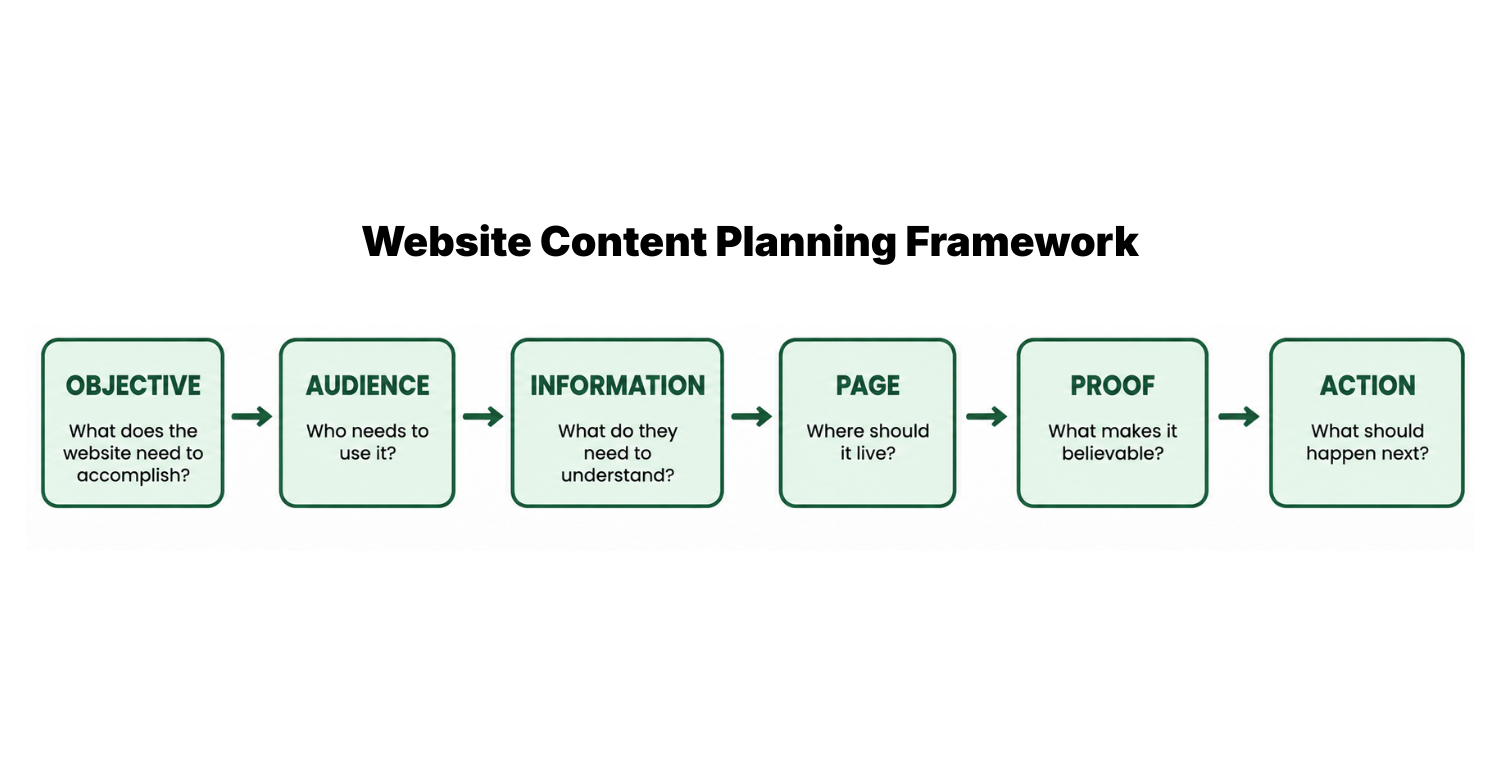
A website content strategy is the plan for what your website needs to communicate, how that information is organized, what each page needs to accomplish, and how people will find and move through the content.
It starts before you write any copy.
You can have a beautifully written website and still make it difficult for someone to understand what you do, find the information they need, or know where to go next.
Rewriting a headline will not fix a confusing site structure, and stronger calls to action will not do much if the right proof is buried three pages deep.
The strategy behind the content is what connects those decisions.
Positioning determines what you want to be known for. Information hierarchy determines what gets priority. Site architecture and page purpose determine where information belongs. Search intent and SEO influence how people discover it. Proof gives them a reason to believe what you are saying, and conversion paths give them somewhere logical to go next.
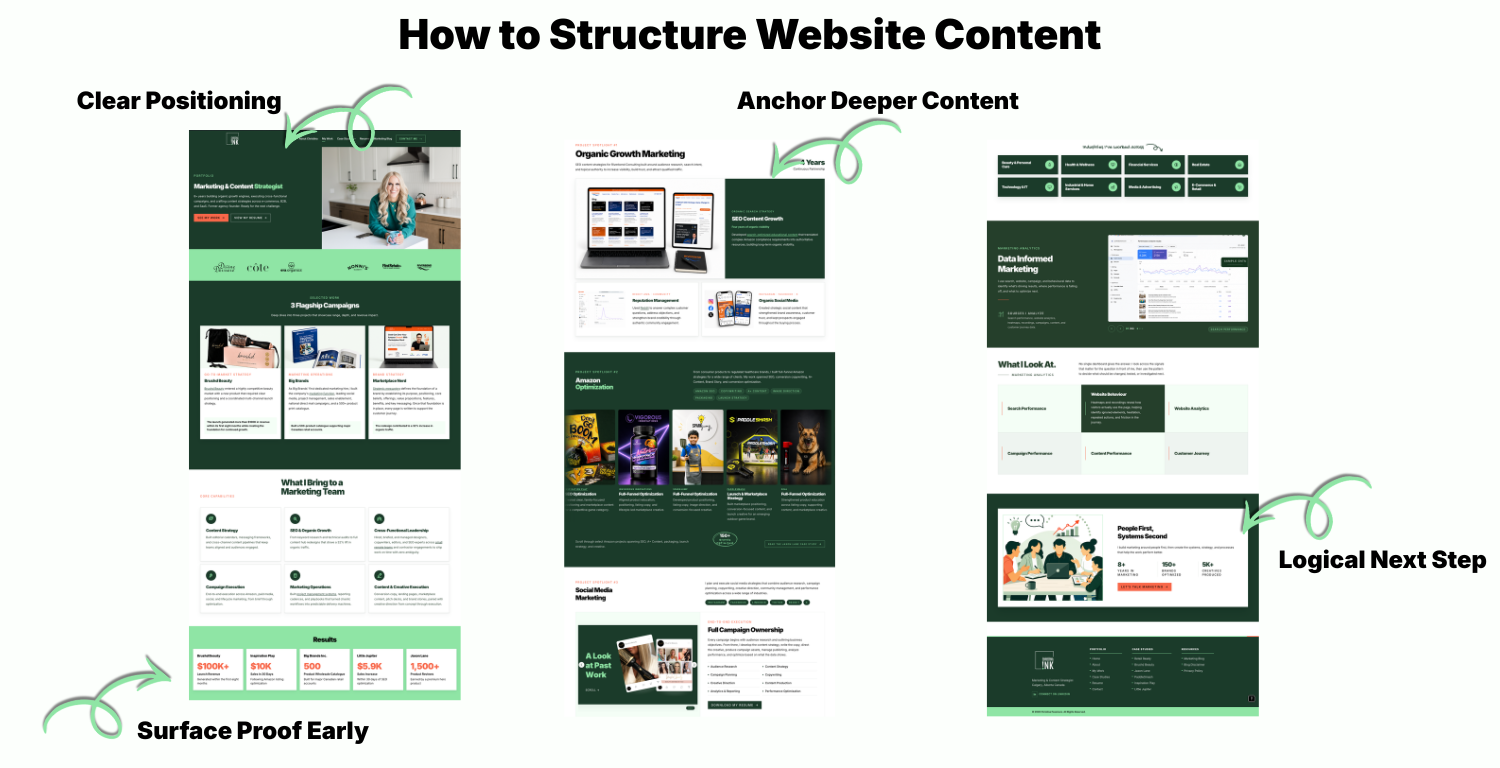
On my own site, that meant deciding which work deserved a dedicated case study, what belonged on the broader portfolio page, which topics deserved their own content, and where someone needed proof before I ever started rewriting the copy.
For example, my My Work page needed to show the breadth of my experience quickly, while an individual case study needed enough room to explain the problem, the strategic decisions I made, the execution, and the outcome. Giving those pages different jobs helped me decide what belonged on each instead of repeating the same information across both.
When I rebuilt the site, I wasn’t simply rewriting pages or giving the design a refresh. I was looking at how all of those pieces worked together and where the experience was breaking down.
AI could help me execute the changes once I knew what I wanted to solve, but deciding what needed to change in the first place was the website content strategy.
Why Website Content Strategy Matters More Now That Content Is Easier to Create
That separation between strategy and execution became much more important once execution got easier.
Website content strategy matters more now because AI has reduced many of the barriers to building and optimizing a website. You can execute more ideas faster, but that makes deciding which ideas are worth pursuing more important.
Copy that once took hours to develop can be explored in minutes. You can research competitors, test page structures, troubleshoot code, create visual concepts, dig into SEO opportunities, and generate new ideas without bringing in a different specialist at every stage.
I experienced that throughout my own rebuild.
If I wanted to add a section, I could create it. If I wanted a different way to showcase my work, I could build it. If I found an SEO opportunity, I could explore how it might fit into the site before deciding whether it belonged there.
The ability to execute wasn’t the constraint. Deciding which possibilities supported the website I was trying to build was much harder.
A new page might create another opportunity to rank, but it could also compete with content already on the site. More copy might answer another question, but it could also bury the information someone came to find. A new feature might improve the user experience, or it could distract from the action I want someone to take.
AI made all of those options easier to produce, but it didn’t make every option worth pursuing.
Website content strategy gave me a way to make those calls based on what the audience needed, how I wanted people to move through the site, what I wanted to be discovered for, and what each piece of content was supposed to accomplish.
How I Audited My Existing Website Before Rebuilding It
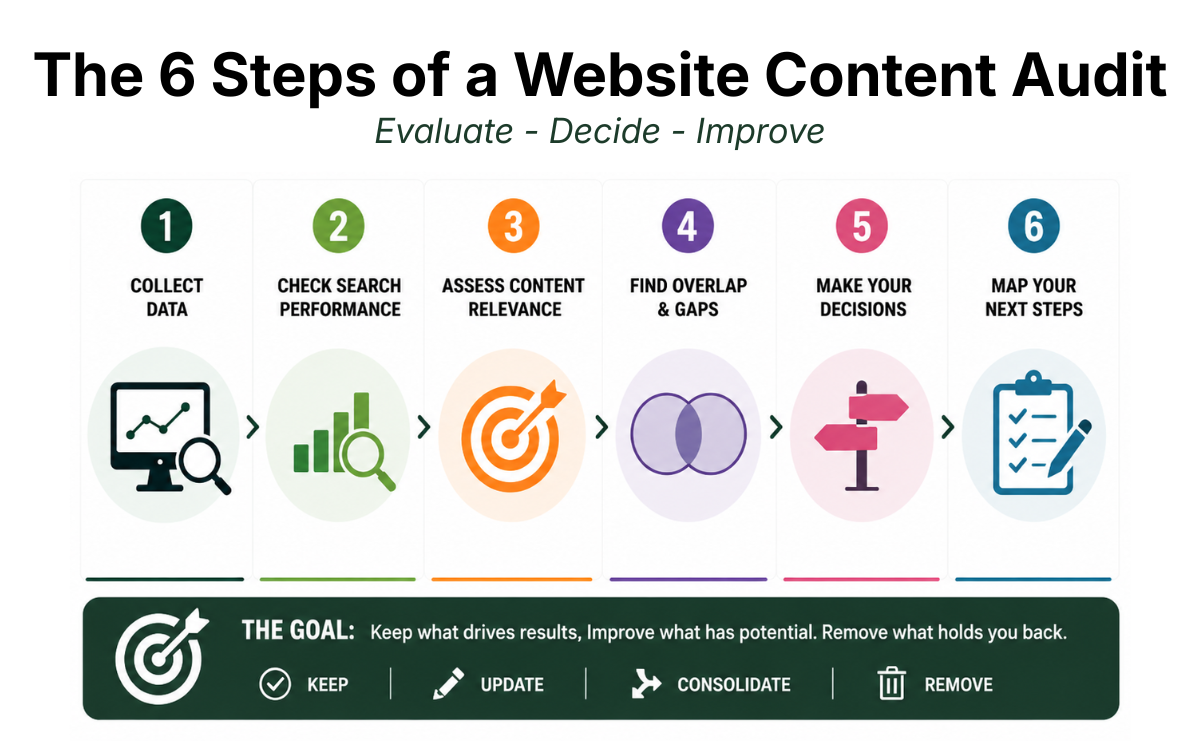
Once I knew I needed a clearer reason for what stayed on the site, I had to figure out what I was starting with.
A website content audit evaluates the content already on your site to determine what still has value, what needs to change, what can be consolidated, and what no longer supports where the website is going.
That last part was particularly important for me.
Christina Ink was originally built around my Amazon listing optimization agency. The site was designed to attract brands looking for Amazon detail page and brand strategy services, so naturally, the pages, blog content, keywords, and positioning reflected that business.
My career had moved on, but much of my website hadn’t.
I now work more broadly across marketing and content strategy, and I needed the site to show that.
Someone landing on Christina Ink needed to be able to see the range of work I had done, how I approached marketing problems, and the strategy behind the execution.
That meant I wasn’t approaching the audit with the assumption that everything valuable needed to be preserved. Some content had done exactly what it was created to do. It simply wasn’t supporting where I wanted to go next.
At the same time, deleting years of content without understanding what it was doing in search would have been a pretty reckless way to start a rebuild.
What Should a Website Content Audit Include
A website content audit should look at how your content is performing and whether it still supports what the website needs to accomplish.
I started with Google Search Console to see which pages were earning impressions and clicks, what queries they were appearing for, and where the site already had search visibility.
Traffic alone wasn’t enough to make a decision. A page with few clicks could still have search visibility, while overlapping pages could be competing for the same intent.
This is also where the audit became more than an SEO exercise. I needed to know whether each page still represented expertise I wanted associated with my name.
I looked at whether the information was current, whether someone visiting the site today still had a reason to need it, whether it supported the broader marketing experience I wanted to showcase, and whether another page was already doing the same job better.
The Amazon content made those decisions particularly interesting.
Google had years of information connecting Christina Ink with Amazon listing optimization. That existing visibility had value, but keeping an entire website positioned around Amazon because search engines already understood it would have meant optimizing for a business I was no longer trying to build.
The SEO data showed me what the old site had accumulated. The website content strategy helped me decide whether that value still belonged in the new one.
How to Decide What Website Content to Keep Update Consolidate or Remove
Once I understood both sides of the site, every piece of content needed a decision.
Keep content that is still relevant, useful, and serving a clear purpose
Update content that has value but no longer reflects your positioning, current expertise, or the search opportunity
Consolidate content when multiple pages are competing to do essentially the same job
Remove content that no longer serves the audience, your positioning, or a meaningful search purpose
In practice, my own audit leaned heavily toward the last option.
I wasn’t trying to turn an Amazon agency website into a slightly broader version of itself. I was repositioning Christina Ink around the work I do now, which meant very little of the old website ultimately made sense to carry forward as it was.
My Amazon experience didn’t suddenly become irrelevant. It is still part of my marketing background and includes work worth showing. What changed was the role I wanted it to play.
Instead of allowing one part of my career to define the entire website, I could preserve the strongest examples of that work in my portfolio while rebuilding the site around a much broader picture of what I could do as a marketer.
That also meant being careful about how I removed old content.
Before changing URLs, consolidating pages, or redirecting something, I wanted to understand whether it had existing search visibility and what I would potentially be giving up.
What the Content Audit Taught Me About Starting Over
The biggest lesson from auditing my old site was that existing value and future value are not always the same thing.
I already knew that removing a page with search visibility can mean giving up rankings and traffic that took time to build.
What became much clearer during the rebuild was that preserving SEO value at all costs can create its own problem when that value is attached to a direction you have already outgrown.
AI made it much easier to explore those tradeoffs. I could investigate what could happen if I removed a page, changed a URL, redirected old content, or rebuilt something around a different search intent.
Google Search Console showed me what the old site was still being discovered for, while AI helped me work through the implications of different options.
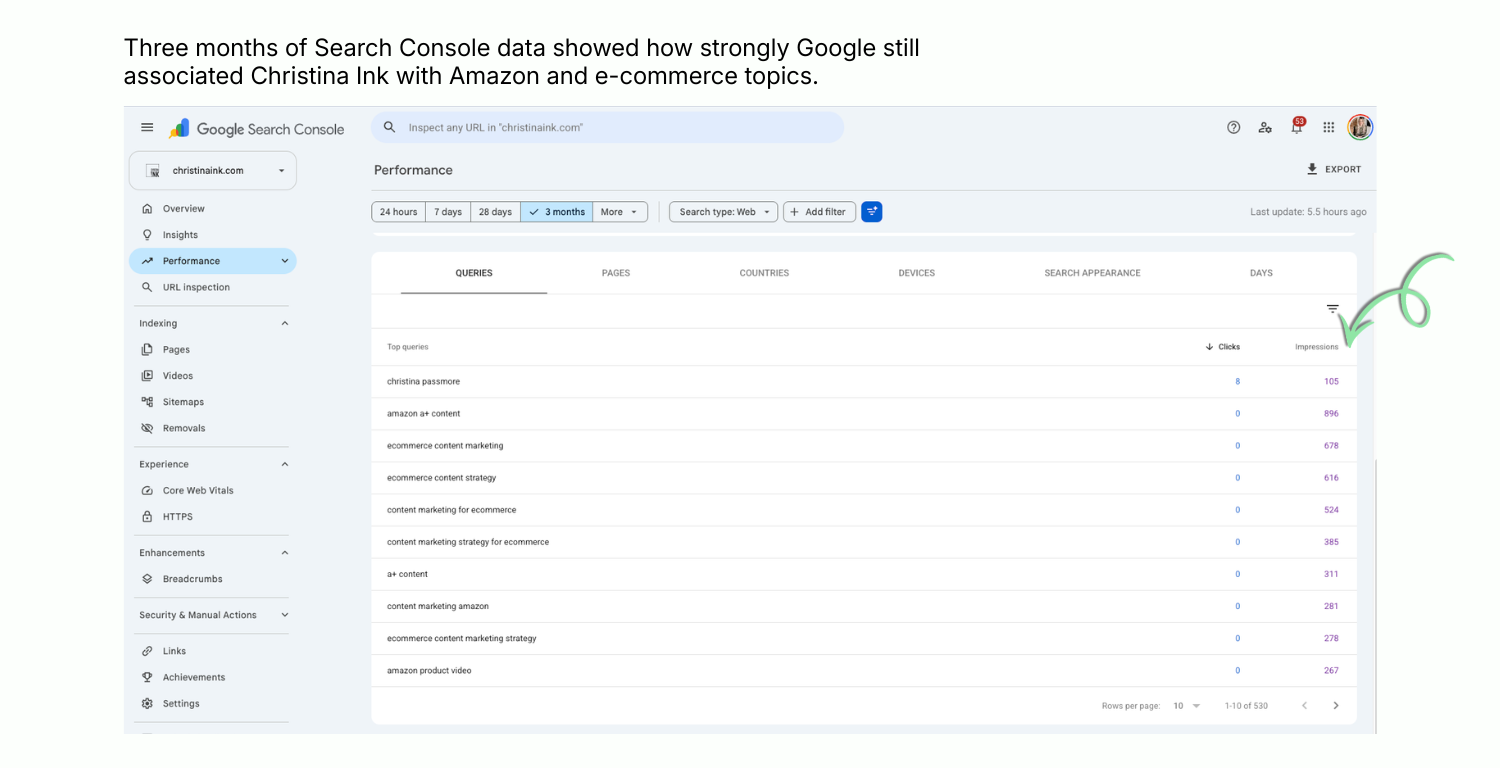 Fig. 1.0 Three months of Search Console data showed how strongly Google still associated Christina Ink with Amazon and e-commerce topics.
Fig. 1.0 Three months of Search Console data showed how strongly Google still associated Christina Ink with Amazon and e-commerce topics.
But I wasn’t going to preserve an Amazon listing optimization agency simply because Google still understood Christina Ink as one.
I had to be willing to give some things up.
Very little of the old website ultimately survived the rebuild. I kept the strongest examples of work that still demonstrated what I could do as a marketer, but I stopped allowing the site’s history to dictate its future direction.
SEO gives us good reasons to protect existing value. This rebuild reminded me that the value still needs to support where the website is going.
Sometimes the strategic decision is to accept losing visibility for something you no longer want to be found for so you can start building visibility for what comes next.