How to Avoid the AI Sameness Trap in Your Marketing
AI has made competent marketing dramatically easier to produce, and your competitors now have access to exactly the same advantage.
You can already see the result in polished LinkedIn posts, SaaS landing pages, paid ads, emails and campaign concepts that are perfectly acceptable but increasingly difficult to remember. None of that marketing is necessarily bad, which is exactly what makes the actual problem easy to miss.
You can also polish the language until nobody could guess AI was involved and still end up with the same customer insight, campaign angle and promise everyone else in the category is using.
That matters much more as AI starts influencing how marketing gets produced, but also how teams research audiences, generate ideas, develop positioning and decide what the campaign should say in the first place.
Quick answer: The AI sameness trap happens when marketers use the same AI tools and widely available information to make decisions their competitors could make just as easily. Avoiding it means bringing proprietary customer intelligence, internal expertise, first-party evidence and deliberate strategic choices into the process before AI starts generating the marketing.
What Is the AI Sameness Trap?
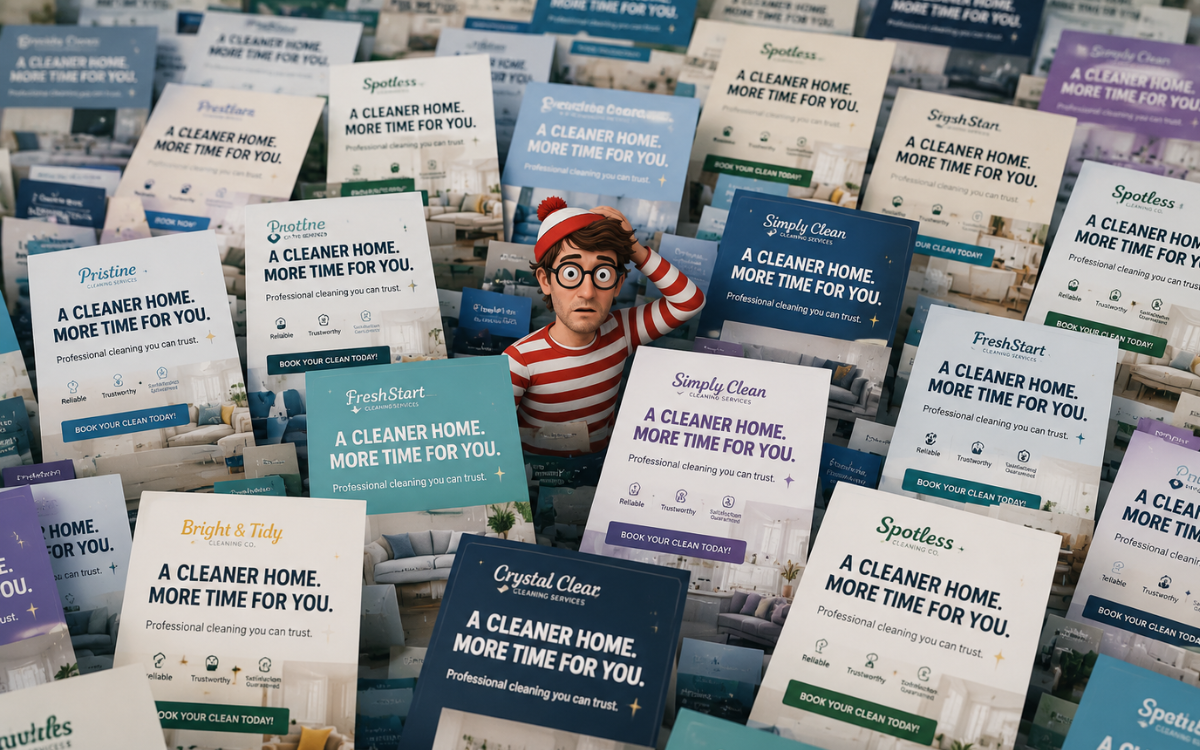
The AI sameness trap happens when businesses use similar AI tools, widely available information and generic inputs to make marketing decisions that increasingly resemble what everyone else in the category is doing.
The easiest version to notice is usually the execution. Certain words, sentence structures, visual styles and creative patterns start showing up everywhere, so marketing teams respond with better prompts, stronger examples, banned-word lists and increasingly detailed brand voice instructions.
Those changes can make the output sound much more like the business without necessarily making the marketing itself more distinctive.
Picture two competing companies asking AI to develop a campaign for the same audience. Both give it strong prompts and detailed brand guidelines, but one company has an irreverent voice while the other sounds measured and authoritative.
The campaigns could sound completely different while still being built around the same customer assumption, similar positioning, a familiar campaign concept and basically the same benefit. The execution changed, but the audience still has very little reason to care which business said it.
By the time AI writes the first headline, some of the decisions making that headline generic may already have been made.
Why Does AI Marketing Become Generic?
Generic AI marketing starts because we ask AI to make specific marketing decisions without giving it enough information to begin with.
Ask an AI tool to identify the biggest problems small business owners have when buying accounting software and you will probably get a reasonable list that includes time-consuming bookkeeping, cash-flow visibility, compliance, cost, complexity and software integrations.
None of those answers are necessarily wrong, but that does not automatically make them useful marketing either.
Your AI tool does not know that your sales team keeps losing otherwise qualified prospects because they misunderstand one particular feature. It does not know that customers repeatedly use one unexpected phrase to describe the problem, and it does not know that one audience segment responds much better when your offer is framed around control instead of convenience unless you give it that information.
Without that context, AI has to work with what it already knows, and much of that same information is available to your competitors.
There is already evidence of this convergence showing up in creative work.
In research discussed by University of Exeter professor Saeema Ahmed-Kristensen, researchers compared ideas from 600 people with 12,000 ideas generated by large language models. AI was extremely good at generating a high volume of ideas, but those ideas were much more likely to cluster around similar concepts, while the human participants produced a more diverse range of ideas.
That matters because generating more ideas isn’t all that helpful when everyone is generating different versions of the same ones.
Sameness Increases Upstream
There’s a big difference between asking AI to generate 20 headlines once you already know what the campaign is about and asking it to decide what the campaign should be about in the first place.
When AI starts identifying the audience, suggesting its pain points, developing the positioning, coming up with the campaign concept, writing the brief and producing the executions, it is influencing much more than production.
That process can be efficient, and there are plenty of situations where AI can improve the thinking along the way. The risk is ending up with a campaign built largely from assumptions and ideas your competitors can access just as easily.
Marketing leaders are already talking about this tension.
TikTok’s head of creative product strategy and operations has warned about generic inputs producing generic AI outputs, while Prudential’s marketing leadership has talked about critical thinking and judgment becoming more important as AI makes competent production easier.
That doesn’t mean marketers should keep AI out of strategy, but it does mean the further upstream you use it, the more important it becomes to bring customer knowledge, business context and actual evidence into the process before you let AI start filling in what it doesn’t actually know.
Why Brand Voice Can’t Solve AI Sameness Alone
Better prompts matter, and so does brand voice, but neither one can give you differentiated marketing if the idea underneath the execution is generic.
A detailed brand system can tell AI that your company prefers plain language, avoids certain phrases, cuts em dashes, and uses shorter headlines or communicates with more confidence than competitors. Give it enough examples and it can get remarkably good at reproducing those patterns, which solves the very real problem of AI-assisted marketing sounding nothing like the company that published it.
The limitation shows up when sounding different gets confused with having something different to say.
Voice Changes Expression
Say two cleaning companies both decide to build campaigns around the idea that hiring a cleaner gives busy homeowners more time back.
One company might use humour about the reality of keeping a house clean with kids, while the other takes a polished approach focused on giving homeowners more time for the things they enjoy.
The campaigns could look and sound completely different while still competing on basically the same idea.
I see versions of this all the time across B2B services and consumer marketing, where the execution is polished but the customer insight or campaign angle underneath it could belong to almost anyone in the category.
Sometimes the generic part is the audience assumption, while other times it is the campaign hook or the benefit every competitor has already decided to lead with.
You can turn any of those ideas into polished copy and strong creative without fixing the problem underneath, which is exactly why marketing teams need to think beyond making AI sound human.
How Proprietary Inputs Prevent AI Sameness
If AI is working with the same information everyone else can access, expecting it to manufacture differentiation at the end of the process is backwards.
The better place to start is with information your competitors do not have, and most businesses already have more of it than they realize.
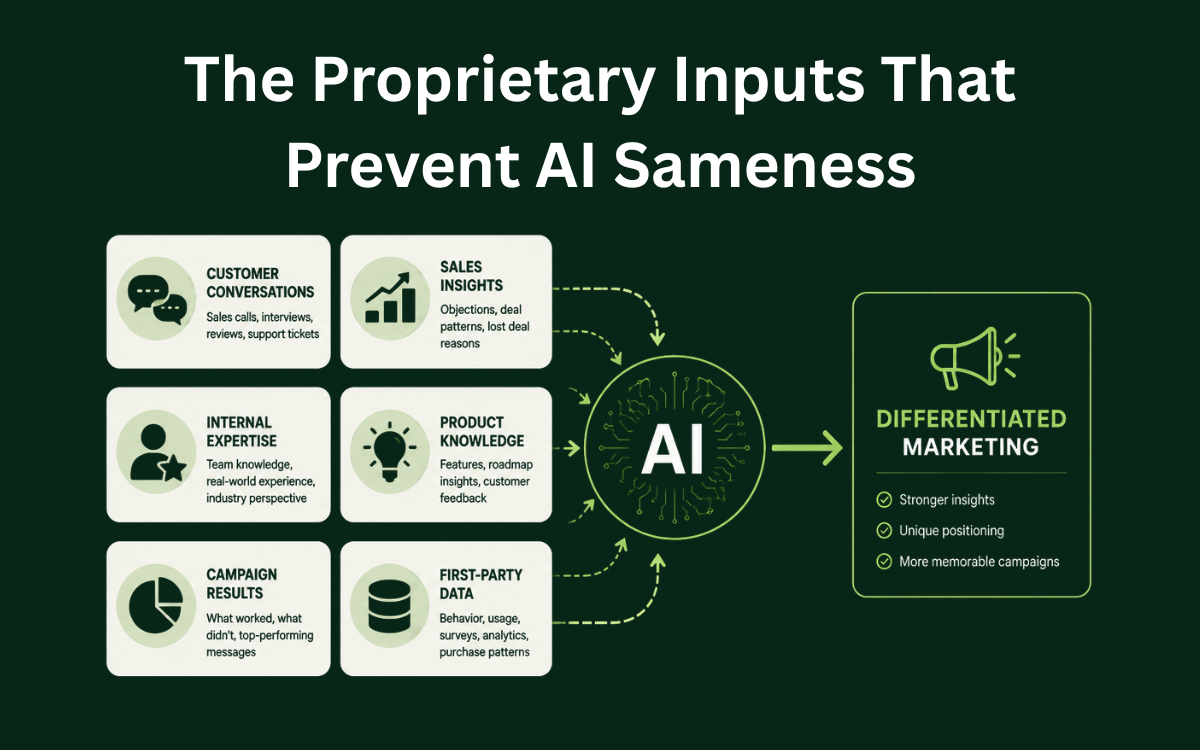
Customer conversations, internal expertise, sales patterns, campaign results, product knowledge and operational experience are being generated inside businesses every day. The challenge is getting that information into the marketing process before AI starts filling in the gaps with what it already knows.
Use Actual Customer Intelligence
There is very little reason to ask AI to guess what your customers think when you already have ways to find out.
Sales conversations, customer interviews, reviews, support tickets, CRM notes, objections, lost-deal reasons, search queries, surveys, purchasing behaviour and retention patterns can all tell you something about the people you are trying to reach.
AI becomes much more useful when you give it evidence and ask it to help you make sense of it.
For example, asking what objections customers might have to a service forces AI to infer what those objections are likely to be. But giving it actual sales-call transcripts and asking which objections keep appearing, when they show up, and what language prospects use turns the same tool into a way of finding patterns across real customer conversations.
A marketer could spend hours going through those calls manually, while AI can help surface the patterns much faster. The important difference is that the model is analyzing your customers instead of inventing customers who sound plausible.
Pull Knowledge Across Teams
Marketing doesn’t hold all the useful marketing information, and some of the best inputs are probably sitting with people who never touch the marketing calendar.
Sales knows which apparently strong leads disappear after the demo, while customer service knows what buyers keep misunderstanding after they purchase. Product knows which features customers ask for and which ones they actually use, and leadership knows which parts of the market the business wants to pursue and which opportunities do not fit.
The people actually delivering the product or service bring another layer because they know where common industry advice breaks down, which problems are more complicated than they appear and which assumptions customers regularly bring into the relationship.
One question I find useful is asking people what they know from doing their job that somebody researching the industry online probably would not know.
Bringing those answers together across sales, product, customer service and the people responsible for delivering the work can change which audience you prioritize, what benefit you lead with, how you position the offer, which campaign concept you pursue and what you decide is not worth saying at all.
Use Your Own Evidence
Your previous marketing results belong in the process too because they can show you where the assumptions you started with did or did not hold up.
Maybe three campaigns built around price underperformed while one focused on implementation speed brought in much stronger qualified leads. Customers might keep asking about one product before eventually buying another, or an audience segment you considered secondary might quietly be becoming one of your most valuable.
Those patterns should affect what you do next.
First-party research, experiments, product usage, sales patterns, campaign performance and customer outcomes can all give AI context it would never have without your business.
You do not need to upload every document your company owns to make that useful. Give AI the information that could actually change the decision you are asking it to help you make rather than overwhelming it with information that has no bearing on the outcome.
Once those inputs exist, AI becomes a lot more interesting at the strategic level.
How to Pressure Test Marketing Strategy With AI
AI can be incredibly useful for challenging a marketing strategy before you commit to it, but it is also very good at making a plausible idea sound more convincing than it actually is.
If you have a positioning hypothesis or campaign direction, give AI the customer evidence behind it and ask it to find the holes. Where is the evidence weak? What assumptions are you making? Could a competitor credibly make the same claim? What might a skeptical customer push back on?
The goal at this stage is to use the model to explore explanations and challenge the one you are already considering.
Expand the Possibilities
Say your team believes customers choose its project-management software because it is easier to use. Before turning that assumption into a campaign, give AI the customer evidence you already have and ask it to identify different reasons ease of use might matter.
Convenience might genuinely be the benefit. But perhaps smaller teams don’t have dedicated operations staff, so every hour spent administering software pulls someone away from another part of the business. Or customers may have struggled through failed software implementations before, making complexity feel less like an inconvenience and more like an adoption risk.
Those interpretations could lead to very different positioning and campaign directions. AI can help surface possibilities you might not have considered, but an interesting explanation isn’t automatically the right one.
Narrow With Evidence
Take the strongest possibilities back to the evidence.
Look at what appears in customer interviews, keeps coming up during sales conversations, shows up in product behaviour or is supported by previous campaign performance. Then consider whether the product can genuinely deliver on the position you’re considering.
If the evidence supports one explanation more strongly than the others, you have a much better reason to build around it than simply choosing the idea that sounds the most compelling.
This is where AI and marketing judgment can work particularly well together. AI expands the possibilities and challenges the assumptions behind them. Your evidence determines which direction deserves to move forward.
Once that decision is made, the strategy is no longer something AI needs to invent. The next job is giving it enough direction to execute it without losing what made the idea worth pursuing in the first place.
How to Build a Differentiated AI Brief
Once the strategic direction is clear, the next job is giving AI enough information to execute it without quietly making new strategic decisions along the way.
How to Avoid Generic AI Marketing
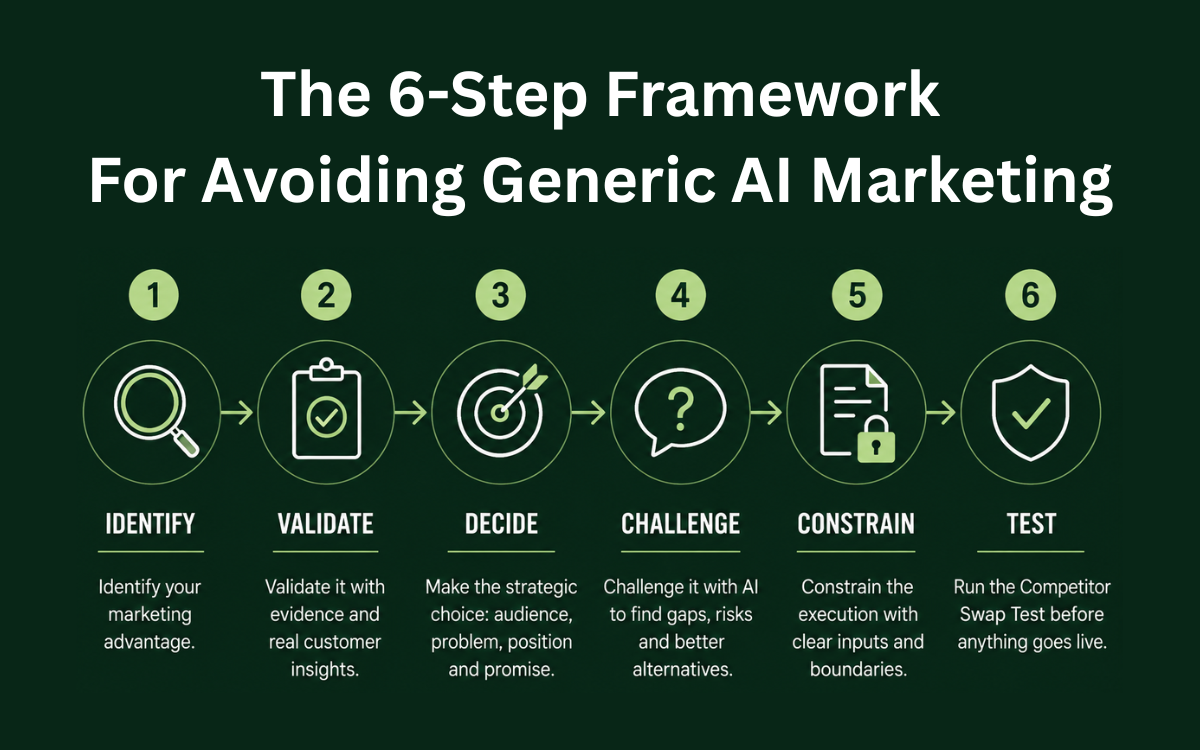
Avoiding generic AI marketing strategy comes down to changing the order in which the decisions happen. Start with what the business knows that competitors don’t.
Use customer intelligence, internal expertise and first-party evidence to identify an advantage worth building around, then make the strategic decisions before asking AI to produce the marketing.
AI can help challenge that thinking, explore different interpretations and execute the strategy across channels, but it shouldn’t have to invent the differentiation itself.
Once the work is produced, check whether that distinction survived. If the final campaign could easily belong to a competitor, go back to the point where the strategy became generic rather than trying to solve the problem with another round of copy edits.
How to Use the Competitor Swap Test to Check for AI Sameness

Once the marketing is finished, remove the logo, company name and obvious brand identifiers and ask whether one of your closest competitors could run essentially the same campaign.
Don’t judge it by voice alone. A campaign can sound completely different while still relying on the same familiar benefit, promise or campaign idea as everyone else in the category.
Compare It With the Original Brief
Go back to the decisions you gave AI before production and compare them with what actually made it into the finished work.
The customer tension, positioning and reason to choose the business should still be recognizable. If a specific problem has turned into a broad benefit or a deliberate position has softened into something any competitor could claim, the execution has drifted.
AI-assisted iteration makes that surprisingly easy to do. Each individual revision can look perfectly reasonable while gradually pulling the work toward something more familiar.
Make the Swap
Now replace your business with a direct competitor.
Could they use the same campaign concept? Could they make essentially the same promise? Would the message still make sense with their product, logo and call to action?
If very little needs to change, don’t automatically rewrite the headline. Go back to the original brief and find where the distinction disappeared.
The final marketing should make one thing easy to identify:
What is here because it came from us?
If there’s a clear answer, the distinction survived execution. If there isn’t, that’s the part to fix before another round of polishing.
Ditch Sameness By Defining Your Own Marketing Advantage First
Your competitors have access to the same AI models, and they all can use relatively the same prompting techniques, build sophisticated brand systems, and automate production just as quickly.
What they cannot generate on demand is what your business has already learned. That’s the part AI should scale, not replace.
If you are figuring out where AI belongs in your marketing without letting everything start looking and thinking the same, connect with me on LinkedIn. I am always interested in comparing notes on where AI is genuinely making marketing better and where marketing judgment still needs to lead.