
Most content strategies still assume visibility is the goal. Rank higher, get the click, win attention. AI-discovery changes that order entirely. In an AI-mediated world, content needs to be interpreted and reused by systems that summarize information on the user’s behalf.
Large language models don’t reward cleverness, volume, or originality on its own. They reward clarity under pressure, content that resolves confusion cleanly, explains trade-offs honestly, and holds up when removed from its original context. Online businesses that understand this are shaping how their category is explained before a buyer ever reaches their site.
Whether you sell on Amazon, run a B2B company, or scale a SaaS product, search is changing, and most online businesses haven’t adjusted. This article breaks down how to create AEO content that large language models can reuse with confidence, helping your business show up accurately in AI-driven discovery instead of being misrepresented or overlooked.
What Is Answer Engine Optimization for Online Businesses?
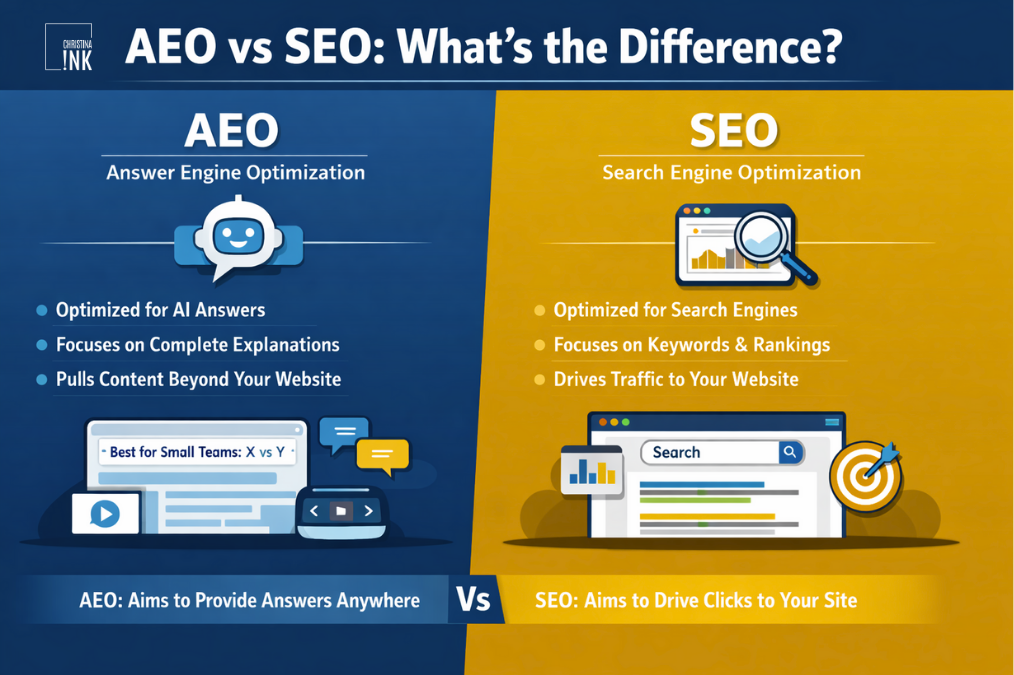
Answer Engine Optimization (AEO) is the practice of creating content designed to be retrieved, synthesized, and surfaced by AI systems when users ask questions. Instead of competing for page-level rankings, AEO content competes at the answer level. Your words may be quoted, paraphrased, or summarized, which means the quality of the explanation matters more than the polish of the page. What AEO is not is “SEO for AI” in the mechanical sense.
AEO is not about stuffing definitions or rewriting content to sound robotic. AEO is also not a replacement for SEO fundamentals, like accuracy, structure, and authority. When businesses approach AEO as a shortcut or formatting exercise, their content tends to disappear rather than surface. The core requirement is still strong thinking; AEO just removes the places where weak thinking used to hide.
AEO vs Traditional SEO: What’s Changed?
Traditional SEO was built around discoverability. Pages ranked, users clicked, and persuasion happened on-site. Even the best content could afford to build slowly, warming the reader up over time. AEO collapses that process. The explanation is often the experience, delivered instantly within an AI response.
The biggest shift is that pages are no longer the primary unit of value; explanations are. Large language models retrieve content in fragments. That means buried insights, vague transitions, and long scenic intros actively work against you. For online businesses, this requires a move away from writing content that “reads well” and toward content that answers well.SEO still drives discovery, but AEO determines whether your ideas become the default explanation in your space.
How SEO, AEO, and Generative Search Optimization Differ
As search evolves, three terms are increasingly used interchangeably: SEO, AEO, and generative search optimization. They overlap, but they are not the same discipline and confusing them leads to shallow strategies.
Search Engine Optimization (SEO) focuses on helping pages get discovered. It prioritizes crawlability, relevance, authority, and intent matching, so content can rank and earn clicks. SEO still matters because it feeds discovery, but ranking alone no longer guarantees visibility once AI systems summarize information for users.
Answer Engine Optimization (AEO) focuses on how explanations are created. It is the practice of structuring content so answers can be retrieved, understood, and reused accurately by AI systems. AEO prioritizes clarity, completeness, and contextual honesty so ideas hold up when removed from their original page and surfaced elsewhere.
Generative Search Optimization (GEO) focuses on influencing how AI-driven search interfaces assemble responses. This often includes formatting tactics, repetition, entity reinforcement, and prompt-aligned phrasing designed to trigger retrieval in AI overviews or chat-style results. While GEO techniques can increase short-term visibility, they don’t guarantee long-term reuse or accuracy.
In practice, SEO drives discovery, AEO determines whether explanations are reused, and GEO influences how often content is surfaced during early-stage AI retrieval. This article focuses on AEO, because explanation quality is the one factor that continues to matter as interfaces, models, and retrieval systems change.
The Core Principles Behind AEO Content That Gets Surfaced
Before getting tactical, it’s important to understand what AI systems consistently favor. AEO-ready content tends to share three traits:
- Decisiveness: The answer is stated clearly before nuance is introduced.
- Completeness: The explanation resolves the question without dangling implications.
- Contextual honesty: Limitations and trade-offs are named explicitly
Answer engine optimization answers questions directly and acknowledges when something depends on circumstances.
Equally important is restraint. AEO content avoids inflating benefits or pretending one solution fits every business. Paradoxically, naming limitations and trade-offs often increase surfacing likelihood because it reduces ambiguity. AI systems are designed to minimize uncertainty for users, and content that is well-reused more often.
Step-by-Step: How Your Online Business Can Create AEO Content That LLMs Can Use
Creating AEO content is a deliberate process. Each step builds toward making your content usable outside your site, and inside AI answers, product research threads, and comparison-driven buying decisions. This matters whether you’re an Amazon seller trying to win the click in a competitive Amazon product category, a SaaS brand trying to shorten a long sales cycle, or a B2B service business competing on trust. The goal isn’t to “game” retrieval, it’s s to become the clearest, most quotable explanation in your category.
Step 1: Start with decision-level questions
Prioritize questions that change what someone buys, installs, renews, or puts in their cart. For Amazon sellers, this looks like “Is collagen powder safe for daily use” or “What’s the difference between stainless steel vs ceramic burr grinders”, questions that help buyers choose between products that all look similar on the surface. For SaaS and B2B, it’s “When does it make sense to switch from spreadsheets to a CRM” or “What’s the real cost of implementing X software”, questions that impact budget, timing, and risk. If the answer can influence a purchase, a shortlist, or a rollout plan, it’s AEO-relevant.
Step 2: Define the audience context explicitly
Don’t make the reader (or the model) guess whether your answer applies to beginners, high-volume sellers, enterprise teams, or regulated industries. Spell out the context in the first few lines: who this is for, what stage they’re in, and what constraints matter. Amazon seller example: “This applies to FBA sellers in Grocery and Health where claims and compliance matter.” SaaS example: “This is for small teams under 25 users deciding between self-serve onboarding and implementation support.” Content that says “it depends” without naming what it depends on rarely gets reused, because it doesn’t resolve ambiguity.
Step 3: Answer first, explain second
Lead with the direct answer in plain language, then earn the right to add nuance. Amazon sellers can think of this like front-loading the “so what” the way a great listing does: the buyer wants the bottom line before they’ll read details. SaaS and B2B buyers are the same; they’re scanning to understand whether something is worth evaluating. Put the decision takeaway in the first 1–2 sentences, then follow with the reasoning, trade-offs, and caveats. Avoid the long narrative warm-up; LLMs don’t reward suspense.
Step 4: Write for extraction, not flow
Assume every section will be pulled out of context and shown somewhere else, like a chatbot answer, a Google AI overview, a sales enablement summary, a Reddit thread, or an internal buyer memo. That means each section has to be independent of surrounding content. Use tight headings that match how people search and compare, then write each section like it’s a self-contained answer.
For Amazon sellers, this is how you win comparison moments: “X vs Y,” “Best for sensitive skin,” “What to avoid,” “How to choose.” For SaaS/B2B, it’s “Best for small teams,” “Implementation timeline,” “Integration requirements,” “Security considerations,” “When it’s not a fit.” Flow matters, but usability outside your site matters more.
Step 5: Reinforce credibility naturally
Credibility isn’t “trust me, I’m an expert” is specificity that can’t be faked. Use real constraints, patterns you see repeatedly, and decision criteria that reflect how buyers actually evaluate.
Amazon seller example: talk about returns triggers, review dynamics, compliance language, category restrictions, and what moves conversion once traffic lands
The best AEO credibility sounds like someone who’s been in the room when the decision got made.
Why Comparison Content and Positioning Are Central to Answer Engine Optimization

Comparison content performs exceptionally well in AI-driven answers because it mirrors how people think when making decisions. Users are asking, “Is this better than that for me?” When businesses avoid comparison, they leave interpretation to the model, which often fills the gap with generic explanations.
Strong AEO comparison content doesn’t declare universal winners. It explains contextual superiority, when one option makes sense and when it doesn’t. Positioning turns comparison into authority by framing trade-offs clearly. The most reusable content often includes sentences like “This works best when…” or “This tends to fail if…”. That clarity is what makes models comfortable surfacing your explanation.
What Chunking Means in AEO Content Optimization
Most people think chunking is a formatting tactic, shorter paragraphs, more headings, cleaner layout. That’s not wrong, but it’s incomplete. In Answer engine optimization for online businesses, chunking is about semantic independence, not readability.A true chunk is a complete answer unit. It can be lifted out of your article, dropped into an AI-generated response, a comparison table, or a buyer’s research summary, and still make sense on its own. If a section relies on earlier context, implied definitions, or “as mentioned above” logic, it’s not chunked; it’s just broken into pieces.
This is why chunking feels hard. It forces you to fully resolve one idea at a time. Every section must answer one question clearly, with no dangling assumptions. When businesses struggle with chunking, it’s usually a thinking problem. The idea itself isn’t finished yet. A well-chunked section does four things simultaneously:
- It clearly states what question it’s answering
- It delivers a direct answer up front
- It includes just enough explanation to stand alone
- It does not rely on surrounding sections for meaning
If you removed every other section from the page, each chunk should still feel complete.
Example 1: Chunking for Amazon Sellers
Question the chunk answers: What actually improves conversion on an Amazon listing once traffic arrives? Well-chunked AEO section:
What improves Amazon listing conversion after traffic arrives?
Once shoppers land on an Amazon listing, conversion is driven by clarity. Buyers want immediate confirmation that the product fits their use case, expectations, and constraints. This is why comparison images, clearly structured bullet points, and accurate benefit framing consistently outperform creative copy alone. Listings that remove uncertainty around size, compatibility, ingredients, or outcomes convert better than those that rely on hype or brand language.
Why this works as a chunk:
- The heading is a searchable question
- The answer is delivered immediately
- The explanation is self-contained
- No reference to “earlier sections” or listing setup basics
If an LLM pulled only this paragraph, it would still be useful.
Example 2: Chunking for B2B Service Businesses
Question the chunk answers: When does content marketing actually influence B2B buying decisions? Well-chunked AEO section:
When content marketing influences B2B buying decisions
Content marketing impacts B2B decisions when it helps buyers clarify risk, compare options, or justify a choice internally. It is most effective during evaluation and consensus-building stages, not initial awareness. Buyers use content to validate assumptions and align stakeholders. Content that explains trade-offs, limitations, and implementation realities is more likely to be referenced and reused during decision-making.
Why this works as a chunk:
- It defines when content matters (not just that it does)
- It names buyer behavior explicitly
- It resolves ambiguity instead of creating it
- It stands on its own without needing funnel context
This chunk could surface inside an AI answer about B2B content strategy without losing meaning.
Example 3: Chunking for SaaS Companies
Question the chunk answers: Why do SaaS buyers stall after demos even when interest is high? Well-chunked AEO section:
Why SaaS buyers stall after demos
SaaS buyers stall after demos when unanswered operational questions outweigh perceived value. Demos show features but avoid implementation effort, data migration, internal adoption, or long-term cost. When these realities remain unclear, buyers pause to reduce risk. Content that addresses post-demo uncertainty, timelines, ownership, change management, and hidden costs will be reused by buyers more than feature explanations.
Why this works as a chunk:
- It answers a very specific decision-related question
- It explains buyer psychology, not just symptoms
- It doesn’t rely on sales-funnel jargon
- It can be extracted and reused verbatim
Step-by-Step: How to Chunk Content Properly for AEO
Chunking is where a lot of agencies, especially growth and performance marketers and SEO agencies, are “gaming the system.” That reality matters, but it’s not the full story. Chunking isn’t just about getting surfaced. Chunking is about earning the right to be reused as the explanation buyers trust.
Chunking requires retrieval mechanics and positioning. Yes, structure matters. Yes, some people are exploiting it. But the online businesses that will keep surfacing long-term are the ones that use chunking to clarify why they’re the best choice, not just the loudest or most formatted.
Step 1: Identify one clear question per section
Every chunk must answer one question. If a section tries to explain what something is and who it’s for and why it’s better, it’s doing too much. Split it.This is where positioning begins. The question you choose determines whether your business is framed as a commodity or as the best-fit solution. “What is X?” positions you as generic. “When X is the best option” positions you as selective and authoritative. The best-performing content answers the right decision-level question and let competitors implicitly fall into second place.
Step 2: Open with a declarative answer
The first sentence of every chunk should resolve the question immediately. This is where many online businesses hesitate because they’re afraid of being wrong or too direct. But AEO rewards clarity.
A clean declarative answer tells buyers and LLMs: this is a usable conclusion. You can still qualify the answer, but only after you’ve given it. Right now, many agencies are front-loading bold answers purely to win retrieval. That works in the short term. But declarative answers only hold if they’re defensible. Thin answers eventually collapse when buyers test them against reality.
Step 3: Expand with explanation and nuance
Once the answer is stated, use the next few sentences to explain why it’s true, when it applies, and when it doesn’t. This is where credibility is earned.
- For Amazon sellers, this might mean naming category restrictions, review dynamics, or compliance trade-offs.
- For SaaS and B2B, it’s about implementation friction, internal adoption, or budget thresholds.
The nuance is what separates “AI bait” from content that will get reused across buyer research, internal docs, and AI summaries.This is also where positioning as “the best” happens naturally. You’re not claiming superiority, you’re showing that you understand constraints better than competitors. That understanding is what LLMs increasingly favor as models mature.
Step 4: Remove contextual dependencies
A chunk must stand alone. That means eliminating phrases like “as mentioned earlier,” “typically” or vague pronouns and references that only make sense if the reader saw the full article.This step feels mechanical, but it’s strategic.
Content that can’t survive outside its original context can’t travel, and Answer engine optimization for online businesses is fundamentally about travel. Right now, some marketing agencies are hacking this by over-simplifying chunks to make them more extractable. That can work temporarily, but it strips away meaning. The better approach is to write complete, self-contained ideas that still reflect real-world complexity. That’s what scales across AI surfaces without degrading your online business.
Step 5: End with completeness
A proper chunk should feel finished. Not like a bridge. Not like a cliffhanger. This runs counter to traditional content marketing instincts, where you’re taught to keep readers moving.
But Answer engine optimization for online businesses is optimized for reuse. A chunk that ends cleanly is more likely to be lifted, quoted, summarized, or referenced.
Let’s be honest: a lot of AEO content right now is engineered to win extraction. Agencies are reverse-engineering retrieval patterns and flooding the system with hyper-structured answers. It’s working for now. But as models get better at evaluating consistency and real-world alignment, shallow chunks will lose ground.
What will remain are explanations that hold up when scrutinized, content that doesn’t just answer quickly, but answers correctly and completely. Online businesses that use AEO chunking as a thinking discipline are the ones positioning themselves to survive that shift.
Chunking isn’t about pleasing algorithms. It’s about becoming the explanation buyers and systems trust when decisions are on the line.
What Your Online Business Should Avoid When Creating Answer Engine Optimization Content
One of the most common mistakes is prioritizing surface optimization over conceptual clarity. Content packed with definitions, buzzwords, or generic best practices tends to blend into the background. Another pitfall is retrofitting old SEO content without rethinking the structure. Long SEO articles with buried insights and soft conclusions rarely perform well in AEO contexts.
Finally, avoid chasing early metrics. AEO rewards consistency and quality over time, not quick wins.
How to Track AEO Performance, and Why Early Signals Can Be Misleading
Tracking AEO performance requires a different mindset than traditional SEO or paid media. Because AEO content is designed to be reused outside your website, inside AI summaries, comparison answers, internal buyer research, and conversational interfaces, its impact rarely shows up as a clean, linear metric.
Early signals exist, but they’re fragmented, indirect, and easy to misinterpret if you’re looking for immediate attribution. This is especially true for online businesses used to dashboards that tie effort directly to clicks or conversions.
Right now, many online businesses are trying to force AI-discovery retrieval into familiar tracking models. That’s where most confusion comes from.
Most teams start by watching:
-
Organic traffic spikes
-
AI visibility tools
-
Featured snippet or “AI overview” appearances
-
Sudden changes in impressions or rankings
The problem is that none of these are stable indicators yet. Large language models update frequently, test retrieval sources continuously, and don’t surface the same answers consistently across users or prompts. Third-party tools attempting to “track AI visibility” are often sampling incomplete data or inferring presence based on limited prompts. A spike can be caused by a model experiment. A drop can happen even when content quality improves. This is why early AEO tracking often feels noisy or discouraging. The system itself is still in flux.
Where meaningful AEO signals actually appear first
The earliest reliable indicators of AEO impact tend to show up outside traditional analytics dashboards, especially for Amazon sellers, B2B firms, and SaaS companies.
One signal is branded search behavior that mirrors your phrasing. When people search your brand name alongside language you’ve used in AEO content, especially comparison terms, qualifiers, or decision framing, it indicates that your explanations are being repeated. This often happens after buyers encounter your content through AI summaries, internal research, or peer discussions, then return to verify the source. At that point, your wording has already shaped how the problem is understood, even if the original interaction didn’t happen on your site.
Keyword Research for AEO Content and Your Online Business
AEO keyword research begins with language under pressure. The kind of language people use when they’re unsure, comparing options, or trying to justify a decision. Tools still matter, but their role has changed. Instead of dictating what you write, they validate whether the language you already see in the wild is worth structuring into AEO content.
This shift is important for online businesses, where buying decisions are rarely made off a single query.
- Amazon shoppers compare
- SaaS buyers evaluate risk
- B2B teams need language they can repeat internally.
AEO keyword research exists to capture that language.
Step 1: Collect real customer language
The most valuable AEO inputs come from how customers explain their uncertainty. Where to look:
-
Customer support emails and tickets
-
Sales calls, demos, or discovery notes
-
Amazon reviews (especially 3–4 star reviews)
-
Reddit threads, Slack communities, Discords
-
LinkedIn comments under industry posts
-
Objection handling docs or FAQs
What to extract:
-
“I’m not sure if…”
-
“What’s the difference between…”
-
“Is this worth it if…”
-
“At what point does it make sense to…”
These phrases are gold because they mirror how people prompt LLMs. They aren’t optimized. They’re natural, situational, and decision-driven.
- For Amazon sellers, this often shows up in reviews and Q&A (“Is this safe for…”, “Does this work with…”).
- For SaaS, it shows up in demos and churn feedback (“We weren’t sure how long implementation would take”).
- For B2B, it shows up in internal alignment language (“How do we justify this to leadership?”).
Step 2: Convert that language into full decision-oriented questions
Raw customer language is rarely structured enough to be reused directly. Your job is to convert it into complete, answerable questions, the kind an AI system or buyer could lift and reuse. Example transformation:
-
Raw: “Not sure if this is overkill for a small team”
-
AEO question: “When is this solution overkill for small teams?”
-
Raw: “Didn’t realize how long setup would take”
-
AEO question: “How long does setup typically take, and what slows it down?”
This step is where AEO diverges from traditional SEO. These questions often:
-
Look longer than typical keywords
-
Read like prompts
-
Include qualifiers (size, stage, constraints)
Step 3: Group questions by decision intent (not topic)
Once you have questions, resist the urge to group them by category or product feature. Instead, group them by what decision the user is trying to make. The most useful AEO intent groups are:
-
Understanding – “What is this and when does it apply?”
-
Comparison – “X vs Y, or option A vs option B”
-
Risk evaluation – “What can go wrong if…”
-
Justification – “How do I explain this choice to others?”
This matters because Answer engine optimization for online businesses surfaces during decision moments,. One AEO post can cover multiple topics, but each chunk should serve one decision type. This is also where positioning happens. Businesses that consistently answer justification and risk questions tend to surface more often than those that only explain basics.
Step 4: Validate with traditional SEO tools
Only now do tools come into play. Use them to:
-
Confirm demand exists
-
Discover alternate phrasings
-
Spot language patterns across markets
Useful tools (for validation only):
-
Google Search Console (queries already triggering impressions)
-
Ahrefs / SEMrush (question modifiers, variations)
-
People Also Ask results
-
Amazon auto-suggest (for Amazon sellers)
-
Reddit search and thread volume
-
Internal site search data (often overlooked)
What not to do:
-
Don’t let search volume rewrite your question
-
Don’t shorten phrasing just to chase numbers
-
Don’t merge questions to “rank better”
If a question matches real buyer language but shows low traditional volume, it may still be highly reusable in AEO contexts. Volume ≠ usefulness anymore.
Step 5: Map one primary question to one primary chunk
This is where most Answer engine optimized content for online businesses fails. Each chunk should:
-
Answer one question
-
Resolve it completely
-
Stand alone without context
Avoid:
-
Stacking multiple questions into one section
-
Using a single chunk to “cover more ground”
-
Ending with unresolved implications
Precision improves retrievability. One clear question → one clear answer → one reusable unit.
For online businesses, this discipline compounds. Over time, you build a library of answer units that:
-
Buyers repeat in sales conversations
-
AI systems reuse in summaries
-
Internal teams reference consistently
Keyword research for AEO is about identifying what explanations your market already needs, then structuring them so they can travel. Tools help confirm that direction and language sets it.
Answer Engine Optimization: Is Your Online Business Ready to Adapt?
AEO content marketing means building explanations strong enough to travel without you. Online businesses that invest in positioning and structure now are future-proofing how their expertise is represented. When your content explains something so clearly that a machine can reuse it confidently, you’re shaping understanding.
While large language models appear to reward clarity, structure, and confidence, yet in practice, many performance marketing agencies are gaming retrieval systems through aggressive formatting, repetitive phrasing, and high-volume “answer-shaped” content. In the short term, that approach is working. But retrieval systems are still maturing, and early movers who understand how models ingest and surface text can manufacture visibility without necessarily offering deeper insight.
Where this breaks down is durability. As models improve, they increasingly favor explanations that hold up under synthesis and without internal contradiction. Clever formatting and volume can trigger retrieval, but they don’t guarantee reuse.
Over time, large language models reduce reliance on brittle patterns and lean toward sources that resolve confusion cleanly, explain trade-offs honestly, and remain useful when stripped of surrounding context. Online businesses that recognize this distinction are positioning themselves to influence how their category is explained tomorrow, after the easy exploits stop working and clarity becomes the real differentiator.
If you’re not sure whether your current content is built for that future, Christina Ink offers a free AEO content audit for online businesses. The audit reviews how your existing content is structured, whether it’s truly reusable by AI systems, and where clarity or positioning is breaking down. You’ll walk away with a clear assessment of what’s working, what isn’t, and how to strengthen your content for long-term discoverability. Get started today and improve how and where your online business shows up.

LIKE THIS ARTICLE?